Below: This is an exact copy of my 1968 Olds 442, same everything right down to the rare factory paint color and Cragar Mag wheels.
Mine came with a 4-speed, 400 ci motor, 4:33 gears and a bench seat.
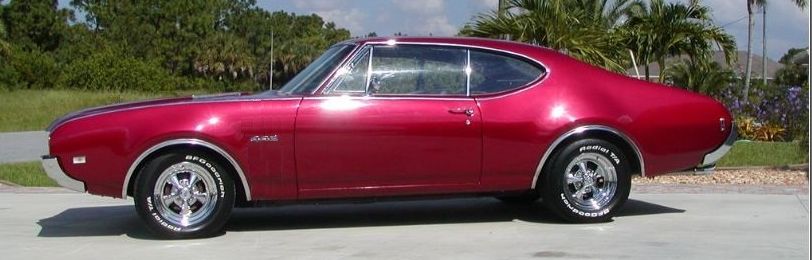
However, I modified my 442 with an engine change. I pulled the 400 c.i. Olds engine and dropped in a Chevy 396 Big Block. This was a 325hp block that I modified.
My best ET was 8.20 at 89 mph @ Spencer Speedway in 1979.
Edelbrock Tarantula Manifold
Holley 780 cfm Double Pumper carb
Appliance Single Flange 1 1/2" Headers
Sig Erson Eliminator Series E-120026 Hydraulic Camshaft
Duration @ 0.050 IN 310° 244°, Gross Lift .578", Lobe Center 110°, Advance 5°
Duration @ 0.050 EX 320° 254°, Gross Lift .603"
4:33 - 1 Rear Ratio Gears
4 speed Muncie transmission
Heads Ported by myself
Below:
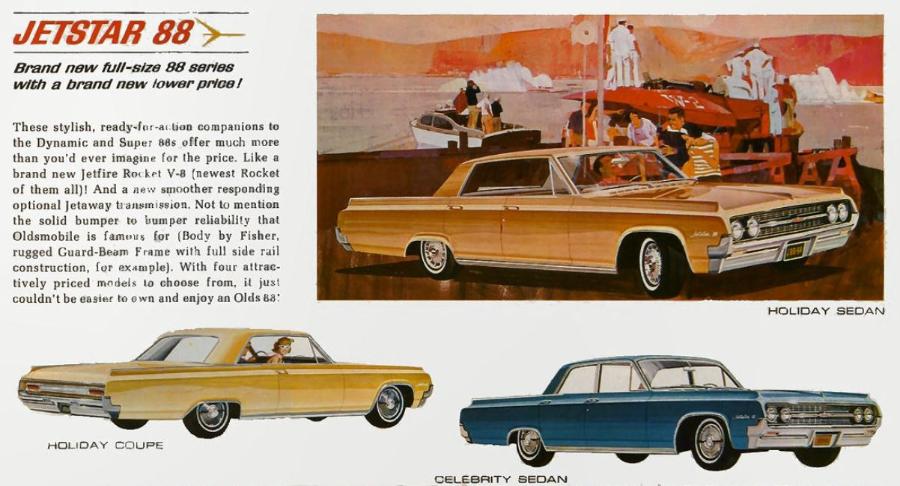
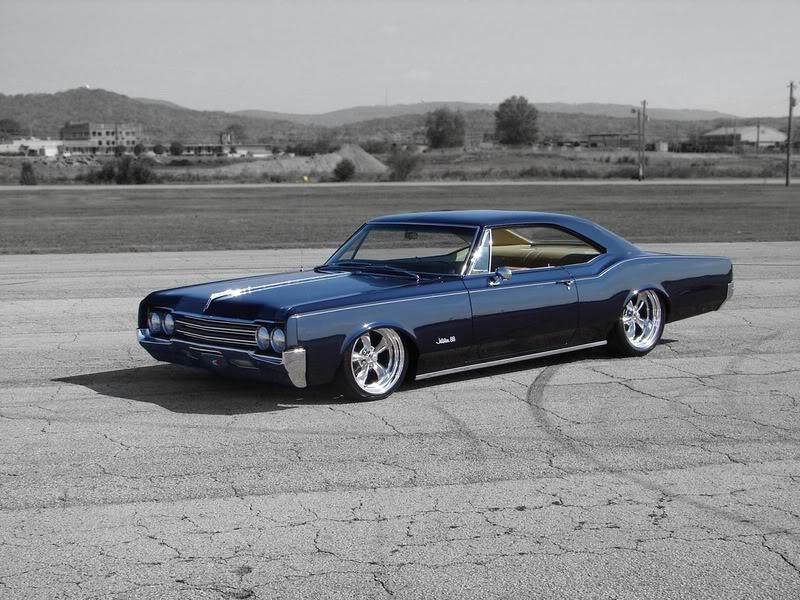
1965 Jetstar 88.
Below:
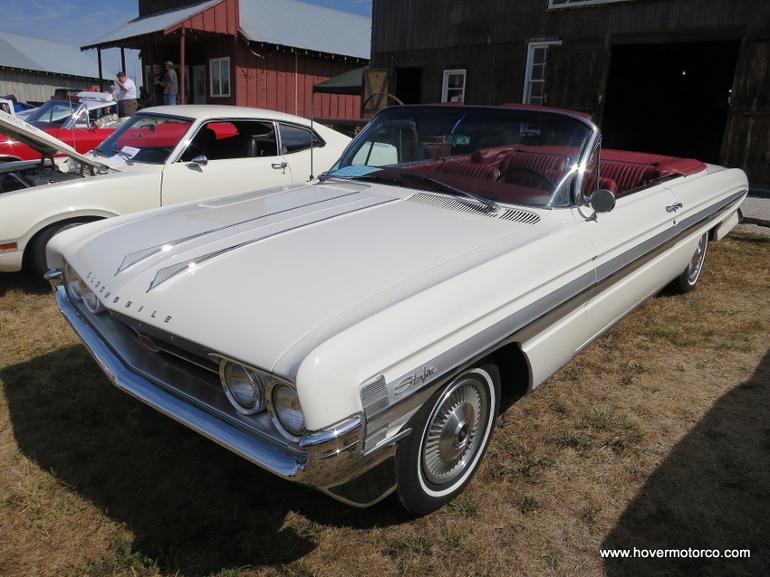
1965 Starfire.
Oldsmobile has an enviable history of performance and innovation. That’s easy to forget if your last memory is when General Motors closed them down in 2004. But rest-assured, at times this company was as hip and popular as they came. Let’s take a look.
That’s not to say they shouldn’t be. Oldsmobile has an enviable history of performance and innovation. That’s easy to forget if your last memory is when General Motors closed them down in 2004. But rest-assured, at times this company was as hip and popular as they came. Let’s take a look.
The Oldsmobile car company officially went into business in 1897, but things really got going with the Curved Dash in 1901. Henry Ford officially created the automotive assembly line for the Model T, right? Nope. Ransom Eli Olds beat him to it with the Curved Dash. Those first Oldsmobile automobiles weren’t cheap, but they were among the best of their time. Come away with me, Lucille.
Here are some other Oldsmobile firsts. They introduced chrome-plated trim in 1926. They were the first to offer a fully automatic transmission, the Hydra-Matic, in 1940. They had one of the first high-compression overhead-valve V8s in 1949. The Toronado became the first front-wheel-drive General Motors car and one of the first mass-produced front-drivers in 1966. And in 1997, Oldsmobile was the first American car company to turn 100 years-old.
Let’s talk about that V8 that showed up in ’49 for a moment. Many people credit the Pontiac GTO or some other ‘60s car as the first factory-built muscle car. But the idea of putting a powerful V8 in a small-bodied car can easily be traced to the ’49 Oldsmobile. An Olds 98 was a pretty big car—the size of a Buick Roadmaster. But the 88 had the same bones as the Chevrolet, a car that only came with a Stovebolt inline-6.
So here it was; an Oldsmobile that was the size of a Chevy, with a 303-c.i., state-of-the-art overhead-valve V8 that they called the “Oldsmobile Rocket.” A Super 88 with a four-barrel carburetor was good for 160-hp and 265 lb/ft of torque. The venerable Ford Flathead V8 could only churn out 100-hp at the time, so this was a pretty big deal. There’s a reason that these cars kicked everyone’s hineys on the NASCAR circuit. For their time, these were muscle cars—there’s no two ways about it.
Oldsmobile continued to develop and prosper throughout the 1950s thanks to the might and power of parent company General Motors. Oldsmobile was the subject of several Motorama dream cars during that time, and in 1953, one of those Harley Earl-designed dream cars arrived in dealer showrooms. Cadillac had the Eldorado. Buick had the Skylark. Chevrolet had the Corvette. And Oldsmobile had the Fiesta, an uncompromising, lavish, expensive convertible that was the flagship of the lineup. Only 458 were built, but that shouldn’t be surprising. At $5,717, it cost $2,754 more than a regular 98 convertible.
Another cool Oldsmobile model was the Starfire, which came out in 1961. It was named after a 1953 Motorama dream car, which itself was named after a Lockheed jet fighter. The Starfire was the most expensive Oldsmobile you could buy, and there was a good reason for that. Look at the details—metallic leather upholstery, stainless steel trim, metal grates on the floor, top-of-the-line power plants—this was a Bill Mitchell customized concept car. This is exactly what the legendary designer would have done to a one-off Super 88 to give to his wife. They just happened to be available for the general public.
But the model name that most people associate with Oldsmobile performance arrived on the scene in 1964. That’s when the “442” badge was added to the intermediate-sized F-82/Cutlass. At the time it meant four-barrel carb, four-on-the-floor, and dual exhaust, although that definition changed throughout the run of the series. By 1968, the Cutlass-based 442 became its own model, and it held its own against big-block Chevelles, Pontiac GTOs, Plymouth Road Runners, and the other cast members of the late ‘60s/early ‘70s muscle car era.
Muscle cars may have died out in the 1970s, but Oldsmobile’s popularity certainly did not. The Cutlass was a particularly hot item. A new colonnade style arrived in 1973, and changes and refinements made it one of the best-selling cars in the world by the middle of the decade. By 1977, they were building so many of them that they couldn’t churn out enough engines. Some of them were actually fitted with Chevrolet 350s instead of the proprietary Rocket V8. This was the beginning of the end for specific engines for every General Motors brand.
Following along with all General Motors cars, Oldsmobiles were downsized by the end of the decade and into the ‘80s. Their biggest sales year was in 1985, when they sold an unbelievable 1,066,122 cars. That success didn’t last forever, though. By the 1990s, competition by Lexus, Infiniti, and Acura, combined with an “old man’s car” perception to the brand, marked the end of the line for the once proud automaker. The final cars left the assembly line that they helped create in 2004, and the world lost one of its great automotive icons.